
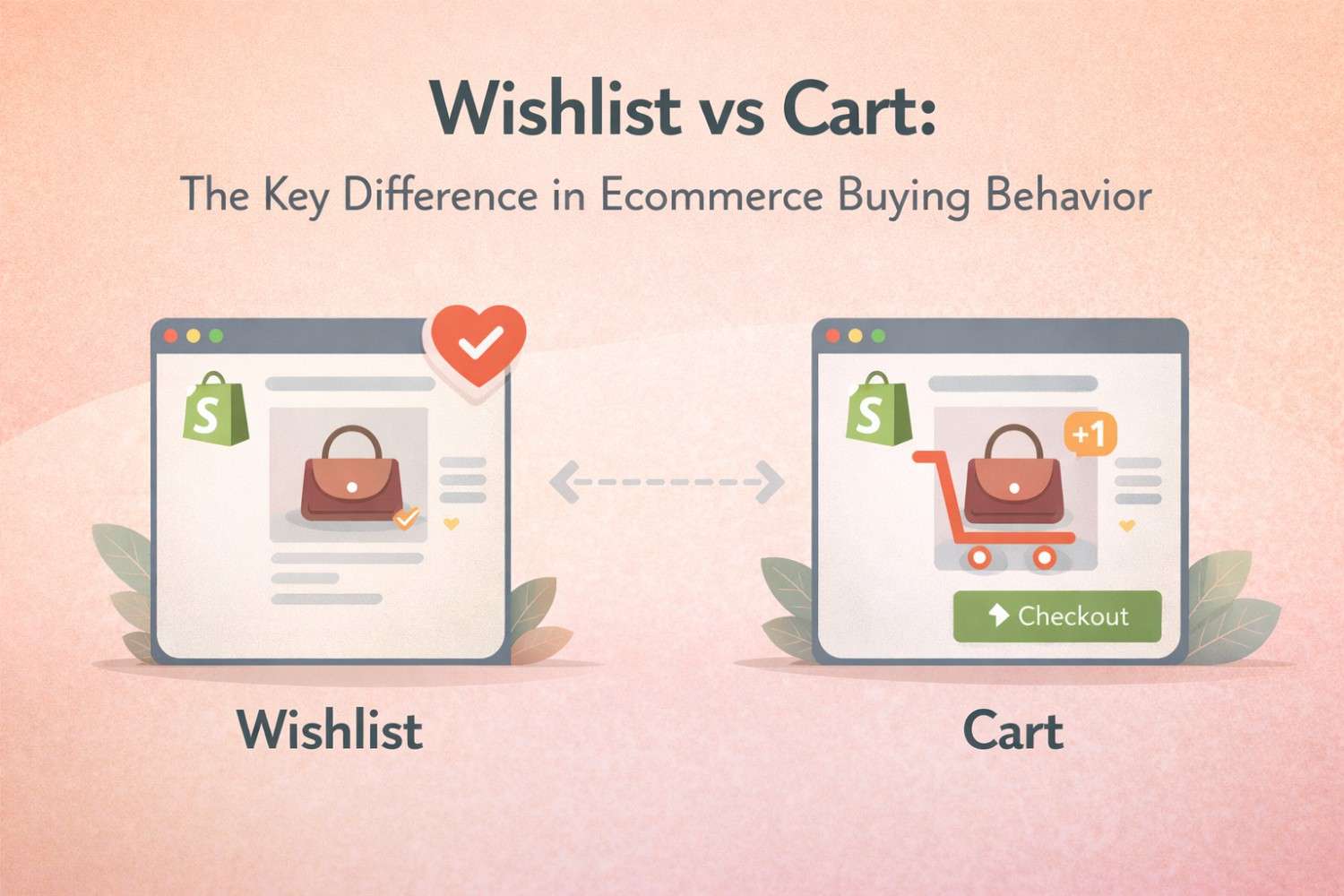
Most Shopify store owners treat the shopping cart as the only metric that matters. If something’s in the cart, it counts. If it’s not, it doesn’t. But that framing misses a massive amount of valuable signal that’s sitting right in front of them. Shopper intent doesn’t always look like an “Add to Cart” click — and stores that only optimize for cart activity are flying half-blind. Understanding the difference between wishlists and carts isn’t just an academic exercise. It’s the key to building a smarter, more profitable marketing strategy.
Key Takeaways:
- A shopping cart and a wishlist tell you very different things about where a shopper is in their journey
- Immediate purchase intent is high with cart adds — future purchase interest is what wishlist saves signal
- Treating both signals the same way leads to missed conversions and tone-deaf marketing
- Cart and wishlist activity together give you a complete picture of customer demand
- Shoppers who save to wishlists are warm leads — they just need a different kind of follow-up
- Shopify stores that read both signals correctly convert more without spending more on traffic
Why Understanding Shopper Intent Matters in Ecommerce
Not every shopper is in the same place when they visit your store. Some are ready to buy, some are researching, and some are planning ahead. The problem is that most ecommerce stores only build for the first type.
Shopper intent sits on a spectrum:
- High intent — ready to purchase now, comparing final options
- Medium intent — genuinely interested, needs more time or a trigger
- Low intent — browsing, exploring, no clear timeline
The cart captures high-intent shoppers well. It’s designed for that. But medium-intent shoppers — the ones who like something but aren’t ready — often leave nothing behind. No data, no trail, no way to follow up. That’s the gap where wishlists live, and it’s bigger than most store owners realize.
Understanding shopper intent isn’t just useful for email marketing. It shapes everything — what you show people, when you reach out, what you say, and how you frame offers. Getting it wrong means sending aggressive “complete your purchase” messages to someone who saved something for their birthday three months away. Getting it right means showing up at exactly the right moment with the right message.
The Shopping Cart: A Signal of Immediate Purchase Intent

When a shopper adds something to their shopping cart, they’re telling you something specific: I want this, and I’m considering buying it now.
That’s immediate purchase intent — and it’s the most commercially valuable signal in ecommerce. Cart adds are close to the finish line. The shopper has moved past discovery, past consideration, and is in active purchase mode.
What cart behavior typically indicates:
- The shopper has made a product decision
- Price and timing are the remaining factors
- A friction point (shipping cost, payment process, second thoughts) is what usually stops the purchase
- Follow-up needs to be timely — within hours, not days
This is why cart abandonment recovery sequences work. The shopper was ready. Something interrupted them. A well-timed reminder catches them before the moment passes.
But here’s the thing: immediate purchase intent represents only a fraction of the interested shoppers visiting your store on any given day. Building your entire retention strategy around cart activity means ignoring everyone else.
The Wishlist: A Signal of Future Purchase Interest

A wishlist save communicates something different. It says: I like this, I want to remember it, but I’m not buying right now.
That’s future purchase interest — and it’s not a weaker signal than a cart add. It’s just a different one. The shopper is interested enough to take an action, but the timing isn’t right yet.
What wishlist behavior typically indicates:
- The shopper has genuine product affinity
- Something is holding back the purchase — budget, timing, waiting for a gift occasion
- They intend to return — they just need a reason or a nudge
- The follow-up window is longer and the messaging should be softer
The mistake most stores make is either ignoring wishlist data entirely or treating it like cart data — blasting urgent “don’t miss out” emails to people who were never close to buying right now. That approach burns goodwill without driving conversions.
Future purchase interest needs to be nurtured, not rushed.

Key Behavioral Differences Between Wishlists and Carts
The behavioral differences between wishlists and carts come down to timing, commitment, and context. Here’s a side-by-side breakdown:
Understanding these behavioral differences changes how you segment your audience, how you write your emails, and how you time your outreach.
A shopper with five items in their cart and a shopper with five items on their wishlist are not in the same place. Marketing to them identically is like sending the same message to someone who just sat down at a restaurant and someone still deciding whether to go out at all.
Why Cart and Wishlist Signals Require Different Marketing Approaches
Cart and wishlist signals each call for a distinct playbook. Here’s what effective follow-up looks like for each:
Cart Abandonment
- Send the first reminder email 1-2 hours after customer abandoned cart. Include specific products in the abandoned cart.
- Address the likely reasons why customer abandoned their cart (free shipping minimum or returns are easy).
- Use urgency to create a sense of need to complete the transaction (limited availability or time-sensitive offer).
Wishlist Follow Up
- Wait for a prompt to reach out to the customer (price change, item available again or seasonal promotion).
- Provide help rather than urgency in follow up emails.
- Personalize the follow up emails to the items saved on the wishlist.
- Provide the customer with options to view similar items.
The marketing approaches that work for carts feel pushy when applied to wishlists. And the patient, trigger-based approach that works for wishlists lets cart abandoners cool off and buy elsewhere.
Matching the message to the intent is what drives conversion. Mismatching them is what drives unsubscribes.
What Shopify Stores Can Learn from Cart and Wishlist Activity
Together, cart and wishlist activity give you a complete map of demand across your store. Most stores only read half of it.
What combined data tells you:
- High saves, low cart adds — strong product interest, possible price resistance or timing issue
- High cart adds, high abandonment — checkout friction or shipping cost issue
- High saves converting to purchases — your wishlist follow-up sequence is working
- Products with many saves but no purchases — candidates for a targeted promotion
Shopify stores that track both signals make smarter inventory decisions, write better emails, and design more effective promotions. A product with 200 wishlist saves is telling you something valuable before the sales data confirms it.
The stores winning at retention aren’t the ones with the biggest audiences. They’re the ones reading their audience most accurately — and acting on what the data says.

Conclusion
The cart and the wishlist are both telling you something. One says “I’m ready.” The other says “I’m interested.” Treating them the same — or ignoring one entirely — leaves real conversion opportunity on the table.
If your Shopify store isn’t capturing and acting on wishlist data yet, WishlistSuite is the tool that makes it simple. It gives your shoppers a native, seamless wishlist experience while giving you the data and automation to follow up intelligently — price drop alerts, restock notifications, reminder sequences, and conversion analytics all in one place.
Do not only focus your retention strategy on the cart. WishlistSuite gives you the ability to measure all aspects of consumer intent from wanting an item in the future to purchasing it right now. Incorporate this tool into your Shopify store today, and begin converting saved items into purchase sales!
Frequently Asked Questions
- Is wishlist data actually useful for marketing, or is it just a nice feature?
It’s genuinely useful — often more actionable than general browsing data. A wishlist save is an explicit signal of product interest, which makes every follow-up communication directly relevant to something the shopper already expressed affinity for. Stores using wishlist data for triggered email campaigns consistently see higher open rates and conversion rates than those relying on generic promotional emails.
- Should I prioritize recovering cart abandonment or wishlist follow-ups?
Both matter, but they require different urgency levels. Cart recovery should be your first priority because immediate purchase intent is highest and the window is short — hours, not days. Wishlist follow-ups can be more patient and trigger-based. Ideally, you run both in parallel rather than choosing between them.
- How do I know when to follow up with a wishlist saver?
Event-based triggers are most effective when it comes to follow-up emails – such as when an item drops in price, is back in stock or when there is a seasonal sale that coincides with a specific timeframe. Following up on purchases in this way generally feels helpful rather than inconvenient as the email relates to something that has happened in regards to the product. Time-based triggers (e.g., 14 days after saving an item) can also serve as an additional layer of follow up and provide an opportunity for an email to be sent.
- Do shoppers actually come back and buy from wishlists?
Yes — and at higher rates than most store owners expect. Wishlist-driven return visits convert significantly better than cold traffic because the shopper already knows the product, already expressed interest, and is returning with specific intent. The future purchase interest captured at save time often converts within days or weeks when the right trigger is present.
- Can WishlistSuite handle both wishlist and cart data in one place?
WishlistSuite is purpose-built for wishlist management on Shopify — capturing saves, sending automated alerts, and tracking which wishlisted products convert to purchases. For a complete picture of cart and wishlist activity, it integrates cleanly with your existing Shopify setup and email platform, giving you the behavioral data you need to run smarter, more targeted follow-up campaigns.