
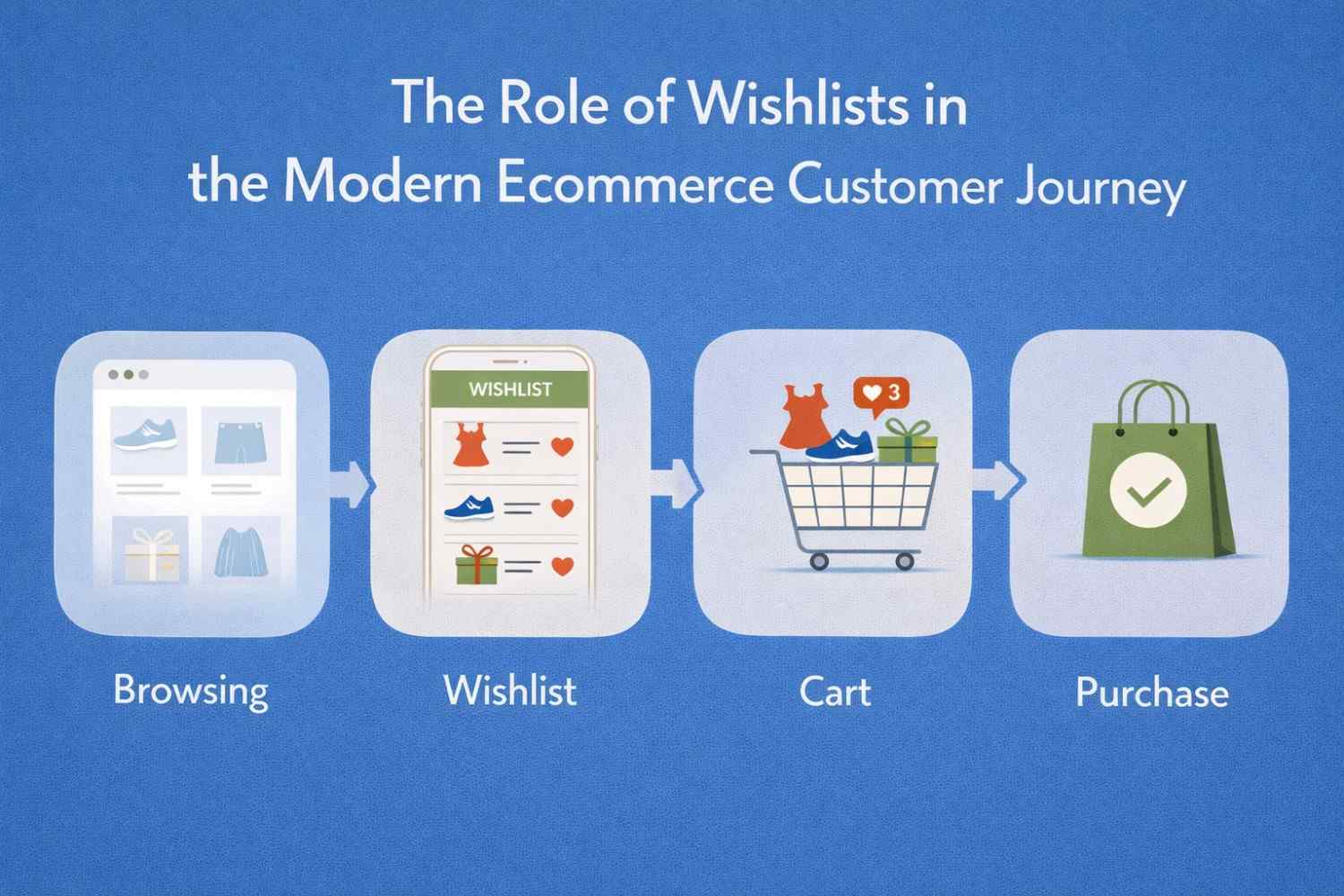
The online shopping journey has never been a straight line — and in 2026, it’s more winding than ever. Shoppers discover products through social media, research them on their phones, revisit them on laptops, and finally buy — sometimes weeks after that first click. If your Shopify store isn’t built to support that kind of non-linear ecommerce customer journey, you’re losing sales not because your products aren’t good enough, but because your store isn’t designed around how people actually buy. Wishlists sit right at the center of that gap, and stores that use them well don’t just improve experience — they measurably improve revenue.
Key Takeaways:
- The modern online buying journey spans multiple sessions, devices, and days — rarely one visit
- Most shoppers need a structured way to save and return to products they love
- A shopping wishlist captures purchase intent before it disappears
- Shopper insights from wishlist data are more actionable than general traffic analytics
- E-commerce personalization improves dramatically when you know what shoppers have saved
- Stores using the best wishlist app for Shopify convert passive browsers into repeat buyers
How the E-commerce Shopping Journey Has Changed
Five years ago, the customer journey online shopping looked relatively simple. Someone searched for a product, clicked through to a store, and either bought or didn’t. The session was short, the decision was fast, and the path was mostly linear.
That’s not how digital journeys work anymore.
Today’s shopper might:
- Discover a product through an Instagram reel
- Visit the store on mobile, browse for a few minutes, leave
- See a retargeting ad two days later
- Come back on desktop to read reviews
- Add to cart a week later, abandon it
- Finally purchase after a reminder email
The ecommerce customer journey is fragmented, multi-device, and time-stretched. Brands that design for this reality — building touchpoints that keep shoppers connected across multiple sessions — outperform the ones still optimizing for single-visit conversions. Wishlists are one of the most practical tools for doing exactly that.
Why Most E-commerce Purchases Don’t Happen in One Visit

Online shopping behavior data tells a consistent story: the majority of purchases don’t happen on the first visit. Shoppers browse, leave, come back, browse again, and buy — eventually.
Shopper behavior research puts the average number of touchpoints before a purchase anywhere from three to eight, depending on product category and price point. For fashion, home goods, and lifestyle products — categories where taste and timing matter — that number trends higher.
The reasons are straightforward:
- Budget constraints — “I’ll buy it when I get paid”
- Gift planning — “This would be perfect for her birthday”
- Comparison shopping — “Let me see if it’s cheaper elsewhere”
- Simple indecision — “I like it but I’m not sure yet”
None of these are reasons to give up on the shopper. But if your store doesn’t offer a wishlist in Shopify, you have no way to hold that interest in place. The shopper closes the tab, and your product competes with everything else for their attention next time — with no head start.
Where Wishlists Fit in the Customer Buying Journey
The customer buying journey has three broad phases: awareness, consideration, and decision. Most e-commerce tools focus on awareness (ads, SEO) and decision (cart, checkout). The consideration phase — where shoppers weigh options, wait for the right moment, and revisit products they like — is massively underserved.
That’s exactly where a wishlist ecommerce feature lives.
A save for later button gives shoppers a low-commitment way to stay in the consideration phase without losing the thread back to your store. It says: “You don’t have to decide now. Just save it and come back when you’re ready.”
The shopping wishlist app that handles this well doesn’t just store product links — it creates a personalized, curated space inside your store that the shopper feels ownership over. My saved items becomes a destination, not just a feature.
That sense of ownership matters. Shoppers who save items feel more connected to your store. They’ve invested a small action. They’re more likely to return, more likely to engage with follow-ups, and more likely to buy.
How Wishlists Help Shoppers Organize Products They Love
A good shopping wishlist isn’t just useful for the store — it’s genuinely useful for the shopper. It solves a real problem they have: how to keep track of things they want across a long, fragmented online buying journey.
Shoppers use wishlists to:
- Build gift lists for birthdays, holidays, or weddings
- Track products they want to buy when their budget allows
- Compare similar products saved at different times
- Share recommendations with friends or family
This utility creates stickiness. A shopper who has saved twelve items across three visits isn’t going to switch to a competitor easily — their purchase interest is already organized inside your store. That’s a genuine competitive advantage.
Purchase intent is much easier to convert when you already know exactly what the shopper wants. Wishlists hand you that knowledge on a plate.

Why Ecommerce Brands Use Wishlists to Track Shopper Interest

Beyond the shopper experience, wishlist data is one of the most underutilized sources of shopper insights in ecommerce. Most stores sit on this data without acting on it.
What wishlist saves tell you:
- Which products are generating genuine interest but not converting — pricing or timing issue?
- Which items are frequently saved but rarely purchased — possible friction in the buying process
- Which products have seasonal save spikes — useful for inventory and promotion planning
- Which customer segments save what types of products — enables smarter segmentation
The best wishlist app surfaces these insights cleanly and connects them to your marketing stack. When a product suddenly gets a spike in saves, that’s a signal — and stores that catch it early can run a targeted promotion, adjust pricing, or prioritize restocking before demand peaks.
This kind of shopper insights data doesn’t come from traffic analytics. It comes from knowing what specific shoppers wanted, saved, and came back for.
How Wishlist Data Helps Stores Improve the Shopping Experience
Wishlist data is the foundation of meaningful ecommerce personalization. When you know what a shopper has saved, you can do things generic behavioral data doesn’t allow:
- Send personalized shopping recommendations based on saved product categories
- Trigger targeted emails when a wishlisted item drops in price or comes back in stock
- Build a personalized shopping experience on the homepage that surfaces saved or related items
- Develop a smarter ecommerce personalization strategy that goes beyond “you viewed this”
The difference between a generic “we miss you” email and a “the item you saved is now 20% off” email is enormous — in open rates, click rates, and conversions. One is noise. The other is service.
Ecommerce personalization at this level used to require sophisticated tech stacks and large teams. A well-built wishlist app makes it accessible to any Shopify store, regardless of size.

Conclusion
The modern online shopping journey is long, non-linear, and full of moments where a shopper’s interest can either be captured or lost. Wishlists capture it. Stores that invest in a strong shopping wishlist experience don’t just improve customer satisfaction — they build a more profitable, retention-driven business that grows without being entirely dependent on paid acquisition.
If you’re ready to meet your shoppers where they actually are in their journey, WishlistSuite is the Shopify wishlist app built to do exactly that. From seamless wishlist creation and save for later functionality to price drop alerts, restock notifications, and ecommerce personalization tools — it’s the best wishlist app for Shopify for stores serious about turning browsing into buying.
WishlistSuite gives your customers a reason to come back — and gives you the data to bring them back at exactly the right moment. Install it on your Shopify store today.
Frequently Asked Questions
-
At what stage of the customer journey is a wishlist most useful?
Wishlists are most valuable in the consideration phase — the space between discovering a product and deciding to buy it. This is where most shoppers spend the most time, and where most stores have the least infrastructure to support them. A well-placed save for later option keeps shoppers connected to your store throughout that phase rather than losing them to distraction or competitors.
-
How does wishlist data improve ecommerce personalization?
When a shopper saves a product, they’re giving you explicit preference data — far more reliable than inferred data from page views or clicks. That data powers a genuine ecommerce personalization strategy: targeted emails, relevant product recommendations, personalized homepages, and follow-up campaigns built around what each shopper actually wants. It moves you from guessing to knowing.
-
Do wishlists work better for certain product categories?
They work across categories but tend to perform especially well for fashion, home decor, gifts, and higher-ticket items — essentially anywhere the customer buying journey naturally extends over multiple sessions. Products that involve taste, planning, or larger financial decisions benefit most from the “save now, buy when ready” dynamic that wishlists support.
-
How should I follow up with shoppers who have items on their wishlist?
The most effective follow-ups are event-triggered rather than time-triggered — a price drop on a saved item, a restock alert, or a sale that applies to wishlisted products. These feel helpful and relevant rather than promotional. A general reminder series (7 days, 14 days post-save) works well as a secondary layer for items that haven’t triggered any other event.
-
Is WishlistSuite suitable for small Shopify stores or only large ones?
WishlistSuite is built for Shopify stores at every stage. Small stores benefit from it immediately — it captures the interest they’re already generating but not converting. As stores grow, the shopper insights and personalization features become increasingly powerful. The setup is straightforward, requires no custom development, and delivers value from the first week of installation.