
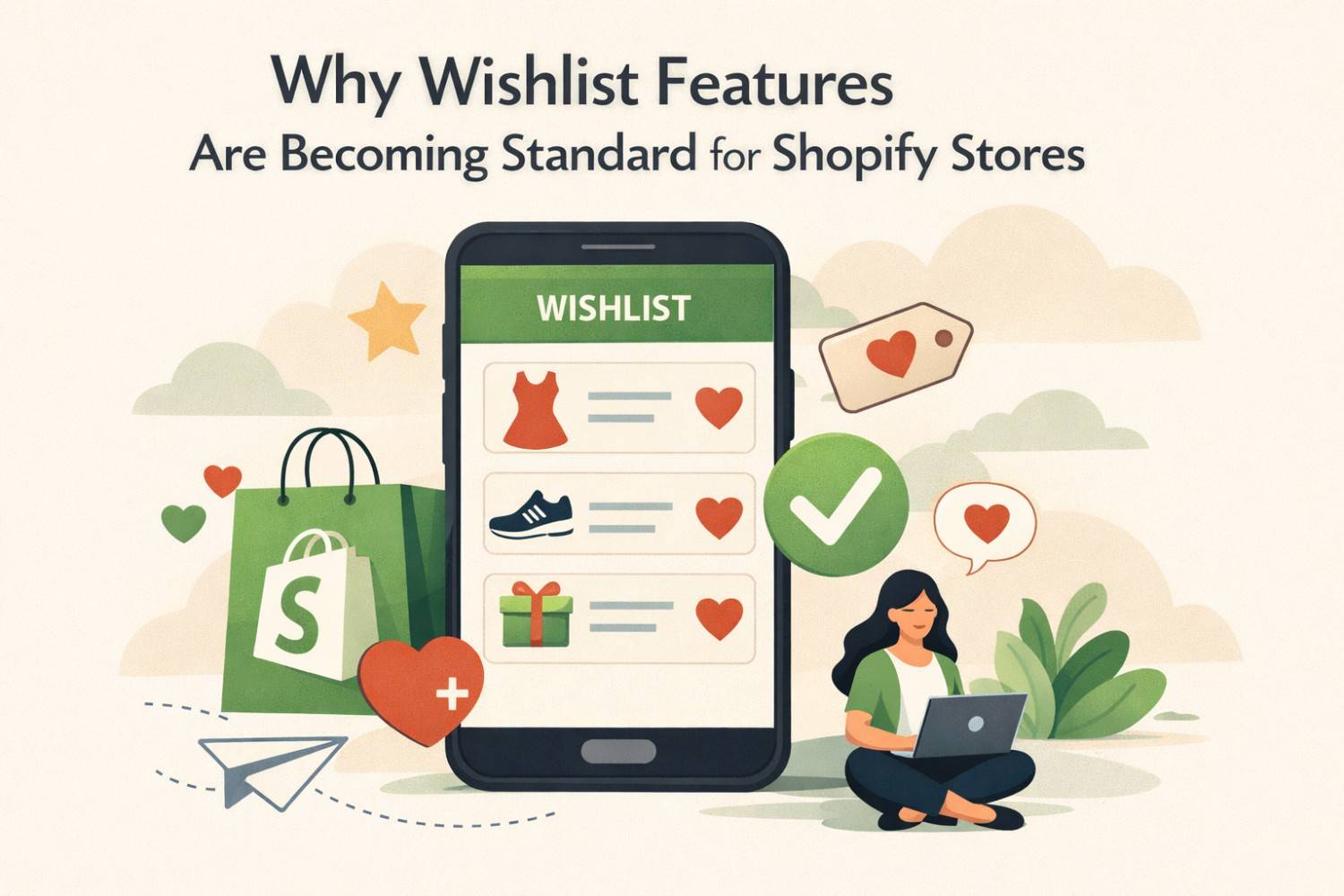
Here’s something most Shopify store owners don’t think about: a shopper browses your store, finds three products they love, gets distracted by a phone call, closes the tab, and never comes back. No purchase. No record of what they liked. Nothing. That’s not a rare edge case — that’s the average online shopping behavior playing out thousands of times a day across ecommerce stores. The question isn’t whether it happens. It’s what you’re doing about it.
Key Takeaways:
- Most shoppers don’t buy on their first visit — they need a reason to come back
- A high bounce rate often signals missing “save for later” functionality, not bad products
- Wishlists reduce cart abandonment by keeping shoppers connected to products they genuinely want
- The consumer buying journey is rarely linear — wishlists accommodate real browsing habits
- Shopify wishlist apps are one of the lowest-effort, highest-return features you can add
- Stores without wishlist functionality are quietly losing customers to stores that have it
The Reality of Modern Ecommerce Shopping Behavior
Let’s be honest about how people actually shop online. They don’t land on a product page, read every detail, and immediately check out. The customer purchase journey looks more like: browse on lunch break, bookmark mentally, forget about it, see a retargeting ad, browse again, maybe buy — or maybe not.
Historically, consumer psychology has acknowledged that making a purchase is a long process; consumers evaluate, delay, and consider their budgets along with the number of times they see or interact with the business before making any final decisions to make a purchase. However, the consumer goods industry has improved its ability to attract consumers through paid search, social media influencers, search engine optimization, and other means. Most retailers still have not improved their post-visit processes for those who did not make a purchase.
The result is a consumer behavior pattern that’s expensive to ignore. Shoppers are more deliberate than ever. They window-shop online the same way people used to walk through malls — not to buy everything, but to note what they want for later. If your store doesn’t give them a structured way to do that, they either forget about you or bookmark a competitor who made it easier.
What Happens When Shoppers Leave Without Saving Products
The average ecommerce bounce rate sits somewhere between 45% and 65% depending on the category. That’s a lot of people leaving. Some of them were never going to buy — wrong audience, wrong price point, wrong timing. But a meaningful chunk of that number? Those are interested shoppers who just weren’t ready yet.
A high bounce rate doesn’t necessarily mean there’s a problem with your store – it could just be due to common mistakes made by most sellers. For example: if a potential buyer looked through your product catalog for four minutes but did not purchase, they may simply want to come back and continue looking but don’t know how. This isn’t because of your homepage headline – it means that you’ve put up obstacles that keep people from being able to continue looking through your site as quickly as possible.
Average bounce rate ecommerce data rarely distinguishes between “not interested” and “interested but not ready.” Both show up as the same number in your analytics. Wishlist features create a bridge for the second group — the ones who were genuinely considering buying but needed more time.
When a shopper saves a product, they’re telling you something. They’re signaling intent. That’s a warm lead, not a lost one. Stores that capture that signal can do something with it. Stores that don’t, lose those shoppers to whoever catches their attention next.

The Rise of “Maybe Later” Shopping in Ecommerce
The consumer buying journey has always had a “maybe later” phase. What’s different now is how long that phase lasts and how many options shoppers have during it. Someone interested in a product today might buy in two weeks when they get paid, or in three months when the season changes. Online shopping cart abandonment is partly a symptom of this — people use carts as temporary holding spaces, not true intent to purchase immediately.
The “save it for later” instinct is strong and normal. Pinterest built an entire platform on it. Amazon’s wishlist feature has been around for decades for good reason. People want a low-pressure way to express interest without committing.
Buying behavior in ecommerce has shifted toward a more research-heavy, comparison-driven process. Shoppers in 2026 are price-aware, review-conscious, and not in a hurry. Giving them a wishlist doesn’t slow down conversions — it actually captures people who would otherwise slip away entirely. The shopper who saves five items to a wishlist is far more likely to return than the one who leaves with nothing saved.
How Wishlists Improve the Online Shopping Experience

The online shopping experience, at its best, should feel like the shopper is in control. Wishlists are a big part of that. They let people curate, plan, and revisit without any pressure. That’s good for the ecommerce user experience because it matches how people naturally want to shop.
From a practical standpoint, the Shopify wishlist feature does a few things well. It gives returning visitors a reason to come back to your specific store rather than starting their search over somewhere else. It creates data on what products are generating interest even when they’re not generating purchases — useful for inventory decisions, promotions, and email campaigns. And it gives you a legitimate, non-intrusive reason to reach out: “Hey, that jacket you saved is back in stock” or “Items in your wishlist are 20% off this weekend.”
That kind of communication doesn’t feel like spam because the shopper opted in with their action. They saved the item. They indicated interest. Following up on that is just good service.
Why Shopify Stores Are Adding Wishlist Features in 2026
More Shopify store owners are realizing that competing on product alone isn’t enough. The best wishlist app options available for Shopify right now are more capable than they used to be — integrating with email flows, loyalty programs, social sharing, and analytics dashboards. The barrier to adding one has dropped significantly.
Wishlist apps that integrate cleanly with your existing Shopify setup can be running within a day. The better Shopify wishlist app options don’t require custom code, don’t slow down your store, and don’t demand ongoing maintenance. For the return they generate in recovered interest and repeat visits, the cost-benefit math is straightforward.
What’s driving adoption isn’t just functionality — it’s competitive pressure. When a shopper compares two similar stores and one has a wishlist and one doesn’t, the one that remembers their preferences wins that relationship. Shopper behavior rewards convenience, and stores that make shopping easier keep customers longer.
The best wishlist app for Shopify isn’t necessarily the one with the most features. It’s the one that integrates smoothly, looks native to your store, and creates actionable data you can actually use.
If you’re serious about improving your ecommerce user experience and reducing drop-offs, it’s time to move beyond just “Add to Cart.”
WishlistSuite is built specifically for modern Shopify brands that understand how customers actually behave.

Conclusion
Wishlist app functionality isn’t a luxury feature anymore. It’s filling a genuine gap in the customer experience — the space between “I’m interested” and “I’m ready to buy.” Every store that ignores that gap is leaving real money on the table from warm shoppers who needed a reason to come back and didn’t find one.
The wishlist app you choose matters less than the decision to add one at all. Start there. Capture the interest your store is already generating but currently losing. That’s the shift that separates stores growing sustainably from ones chasing cold traffic indefinitely.
Frequently Asked Questions
1. Why do customers leave without buying, and how can wishlists help?
Most people don’t come to your store ready to buy instantly. They’re browsing, comparing, or just exploring. The problem is—when they leave, there’s no easy way for them to come back to what they liked. Wishlists fix that. Instead of losing that interest, you let them save products and pick it up later.
2. Do wishlist features actually increase sales?
Not immediately—but over time, yes. When someone saves a product, they’re already halfway there. They just need the right moment to come back. Wishlists help you stay in that consideration set instead of being forgotten.
3. How do wishlists improve the ecommerce user experience?
They take the pressure off. Not every visit needs to end in a purchase. When users know they can save things and return later, they explore more freely—and that actually makes them more likely to buy eventually.
4. Can wishlist data be used for marketing?
Definitely. It’s one of the clearest signals of intent. If someone saves a product, you know they’re interested. You can use that to send better reminders, run more relevant ads, and focus on what people actually want—not just what they click.
5. Is a wishlist feature necessary for Shopify stores in 2026?
Honestly, it’s getting there. With how people shop today—and how expensive it is to get traffic—you can’t afford to lose interested visitors. Wishlist features are quickly becoming as basic as search or filters.